The first verse of the third chapter of the Gospel according to Matthew says:
In those days John the Baptist came preaching in the wilderness of Judea.
We should know that in antiquity the text of the Gospel didn’t appear as it does today, in the sense that the texts written by the apostles were not divided into chapters—this division came centuries later. A reader who would finish the verses at the end of chapter two and immediately read the next sentence: In those days John the Baptist came, might think that the beginning of John’s preaching happened right after the Holy Family returned from Egypt to Nazareth. That’s why the Holy Fathers draw attention to these words and explain which period they refer to. Here’s how Saint John Chrysostom explains it: “In which days? According to the testimony of Saint Luke, John did not come in the days when Jesus was a child and returned to Nazareth, but after thirty years.” The phrase in those days is not used so much to give a precise chronological account of events, but rather to mark a transition to a new section of the narrative. Therefore, John was sent by God shortly before the beginning of the public ministry of our Lord Jesus Christ.
A few words about the context of that time, the time of Saint John’s preaching. It was a very difficult time for the Jewish people. Rome, which had until then somewhat tolerated the supposed independence of Judea and the rule of the Herodian dynasty, deposed Archelaus, Herod’s son. Alongside Roman rule came changes in the life of the Jewish people that they could not bear, as they saw them as impure, pagan. Roman troops, among other things, were stationed right next to the temple in Jerusalem, so even when visiting the greatest pride of their nation, the average Jew could not help but feel discouraged, seeing the occupiers so close to the Holy of Holies. And not only in Jerusalem—the iron fist of Roman authority could be felt in other cities too. The people were often mistreated, taxes increased, and the system the Romans introduced—through a network of tax collectors (publicans) who collected taxes on Rome’s behalf—only made matters worse, since these tax collectors also extorted money for themselves under the guise of gathering revenue for the empire. In various places, rebel groups appeared who refused to pay taxes. They considered refusal a sacred duty and stirred up rebellions against the Romans, which further disturbed the people and caused unrest.
In the midst of such hardship and difficulty, many simply longed to escape to the desert, at least for a while, to pray to God, to rest in solitude and forget the burdens of daily life. In such heavy circumstances, a fiery preacher appeared—a new prophet whose fame quickly spread among the people. Since the time of the last Old Testament prophet Malachi, several centuries had passed without a prophet. The people had become fully accustomed to such a situation and no longer even expected the appearance of new prophets, but only waited for the second coming of the prophet Elijah as the immediate forerunner of the expected Messiah. John, as a strict ascetic, did not only appear in the wilderness “in the spirit and power of Elijah,” but even in his outward appearance and lifestyle, he reminded people of Elijah.
It should be added that when we speak of the Judean wilderness, we do not mean a completely barren desert like the Sahara, without any plants or settlements, but rather a sparsely inhabited area suitable for grazing livestock. This wilderness was the largest in Palestine, and John preached near the Jordan. Commentators explain that the holy Forerunner, among other reasons, preached in the wilderness to avoid the idle curiosity of the crowds, which would have been inevitable had he preached in the cities; also, this allowed him to encounter less resistance from the proud Pharisees and scribes.
Blessed Theophylact of Ohrid says that one of the goals of St. John the Baptist’s preaching on repentance was to make the Jews aware of their sins. Here’s what he writes:
“God sent John to rebuke the Jews and to lead them to the knowledge of their sins so that they might thus receive Christ. If a person is not aware of their sins, they cannot repent. That is why John was sent.”
Here is the second verse:
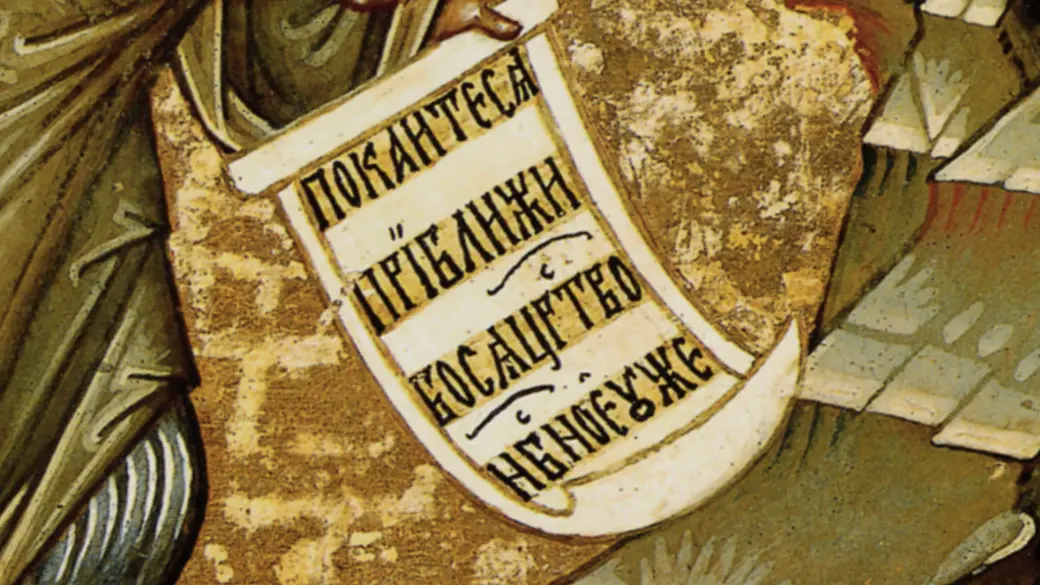
“Repent, for the Kingdom of Heaven is at hand.”
Both the Holy Forerunner and later the Lord Himself began their preaching with the same call to repentance. The Holy Fathers say this was not by chance, for it showed that there was no contradiction in their teachings. We, as Church people, know that repentance is necessary even to begin the journey toward God.
However, it can easily slip from our awareness just how deeply and thoroughly the Holy Fathers treated the subject of repentance. They saw in it the beginning, the middle, and the end of Christian life—its perfection.
St. Ignatius Brianchaninov makes an excellent observation:
“All the saints of the Orthodox Church adhered to repentance throughout their lives, even when God’s grace was clearly working in them. Today, people seek either cold, formal knowledge or false spiritual sensations. Both belong to this world—not to Christ.”
We may forget from time to time that repentance cannot be exhausted. It is not something that can be “completed,” like levels in a video game. The more we progress spiritually, the more the eyes of our soul are opened—and the greater the ocean of repentance before us.
The Fathers warn against viewing repentance lightly and superficially—as if it’s only about going to confession, without truly striving to fulfill the commandments in the meantime, which is actually the essence of repentance.
St. Ignatius also says:
“Do not take repentance lightly—it is the soul of all spiritual effort, the common activity that must permeate every other endeavour. True spiritual progress has been achieved only by those who remain in true repentance. It is the essential work that prepares us for the revelation of the Kingdom of God within us.”
So all of us must live in repentance within the Church, from bishops to laypeople. On this, St. Symeon of Thessalonica writes:
“Repentance is necessary for all: laypeople and monks, priests and clergy, bishops—no one should shy away from repentance, for we all have sinned and continue to sin, and therefore all must repent…”
Now we continue with the third verse:
“For this is he who was spoken of by the prophet Isaiah when he said: ‘The voice of one crying in the wilderness: Prepare the way of the Lord, make His paths straight.’”
The Apostle Matthew here quotes the prophet Isaiah (chapter 40). Isaiah is often called the “Fifth Evangelist” because of the great number of prophecies about Christ—especially about His suffering. The Holy Fathers explain these words from various perspectives.
Blessed Theophylact of Ohrid explains Isaiah’s words by comparing the Old and New Testament laws—revealing the core of what was a stumbling block for many then, and still is today. He writes:
“The ‘way’ refers to the Gospel, and the ‘paths’ to the ordinances of the Law, which have aged and grown old. Therefore it says: ‘Prepare yourselves for a life in the Gospel, and straighten the old paths of the Law’—that is, fulfill them spiritually, for the Spirit is ‘straight.’ So when you see a Jew who understands the Law’s commandments only bodily, you may say: ‘He has not made straight his paths,’ that is, he does not understand the Law spiritually.”
Theophylact mentions the Jews because, in his time, theological polemics with them were still active. But this also applies to all who view the ordinances of the Church only with external eyes—who see fasting as just a diet, the Holy Mysteries as mere rituals to “check off,” and the Church’s teachings as simply a “cultural tradition of our people,” and so on.
Saint Nikolai of Ohrid offers a practical explanation of the words of the Prophet Isaiah, showing their deep connection to the spiritual life of each one of us. He writes:
“Prepare the way of the Lord, make His paths straight. How? Confess and repent. Do these two things urgently, for the Lord is coming. He will knock at the door of every soul. Whoever confesses and repents will keep the door of the soul open, and the Lord will enter and bring eternal life. But whoever does not confess and does not repent will keep the door of the soul rusted shut by sin. And the Lord will pass him by. Yet behind Him comes the axe and the fire, just as before Him comes spring with sunlight, fragrance, and song. The Lord’s ways and His paths are human souls; the unevenness in them are the sins of lawlessness.”
And Saint Justin Popović reminds us of a truth many have forgotten today—that the human race is completely lost without Jesus Christ, and there is no salvation apart from Him. Here is how he explains Isaiah’s words:
“There is no way of the Lord in the wilderness of human life. The path from the soul to God is full of pits—ruined, broken, destroyed by sin. Who can walk it and reach God? Everything human is so desolate from sin and death that it dies helplessly in its vast wilderness. Therefore, there is no salvation for humans that they could invent or accomplish on their own. Salvation can come only from the One who is Sinless and Immortal, and thus powerful and mighty to destroy both sin and death. And yet, you humans can do something: come to your senses, awaken, and recognize both your personal and collective sinfulness—the sins that have locked you in the inescapable prison of death—and let that awareness turn into a spirit of repentance. With that repentance, you will straighten the way of the Lord, and He will come by that way into your life, into your soul, into your desolate and deserted world.”
What Saint Justin describes is something we can clearly see even today—people are trying their best to make life on earth more comfortable, avoiding or even outright rejecting the idea of sin, treating it as some outdated relic or blaming it for psychological issues and guilt. In essence, they are far from understanding sin as an enormous destructive power that only the Lord can stop, subdue, and destroy.
Adapted and edited for contemporary readers based on the commentaries of the Holy Fathers by: Stanoje Stanković