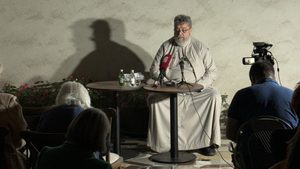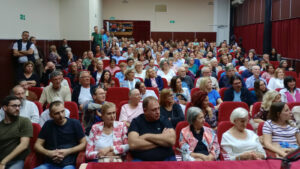

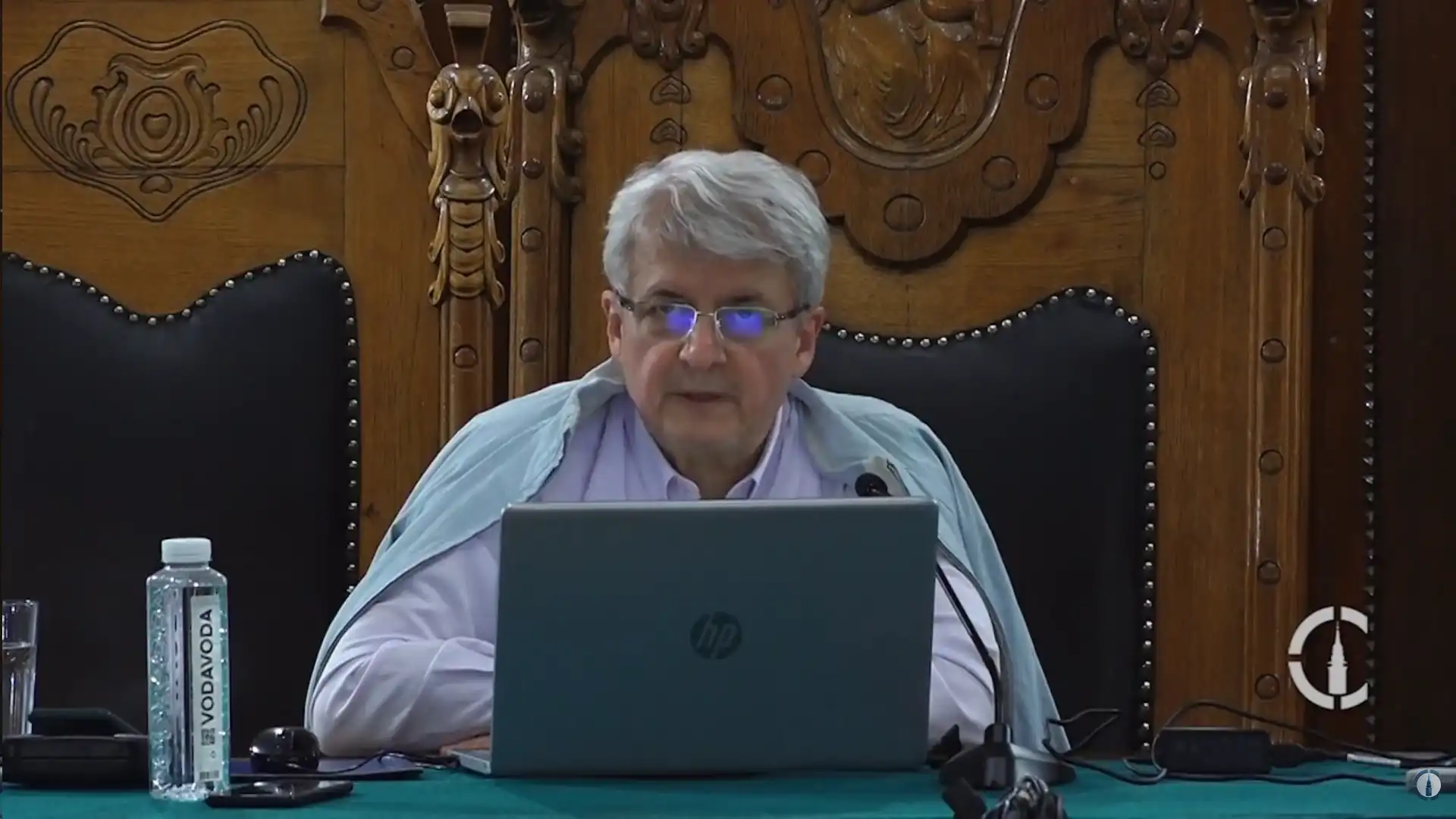
Zoran Lukovic, the Coordinator of the Section for Apologetic Mission, gave a lecture entitled “When does artistic freedom and creative rebellion turn into incitement to evil?” at the forum “Spirit and Culture”, held in the ceremonial hall of the City House in Subotica.
Zoran Lukovic delved into the depths of artistic freedom, analysing the origins of its strength, but also analysing its dangers, using the examples from various cultural and social contexts.
The Simulated Representation of Paradise
The simulated representation of paradise (the images of happiness, abundance, well-being, exotic settings…), adapted to suit personal preferences, is presented to the contemporary man in such a way, that he imagines that all that has been waiting only for him. Artistic freedom and creative rebellion is frequently used to portray this illusion, thus strengthening the belief that the individual lies at the centre of everything.
The Social Mechanisms and the Individual
The current social mechanisms favour the movements and processes which create an “apostle-like” individual, with self-projected divine attributes. The value system supports certain behaviours and statuses, which are seen as desirable. In the complex, sometimes even cruel environment of social competitiveness, the social standing is usually ensured by belonging to certain orientations and/or the avant-garde, usually ideologically-coloured affiliations. Artistic freedom and creative rebellion often serve as tools for promoting these orientations, indirectly and imperceptibly directing the orientations of the modern man.
The Emancipation from Traditional Social Conventions
In such a discourse, the emancipation from the traditional social conventions can be a welcome attribute and an indicator of progress, while the alternative value-system (be it ideological, existential, gender-based or religious…), is held up to be the irrefutable proof of a visionary and prosperous path. Artistic freedom and creative rebellion are frequently at the forefront of this type of emancipation, serving as symbols of the new and alternative values.
Individual Religiosity as a Status Symbol
The practice of individual religiosity is often being suggested as the “initiatory principle”, or even as a desirable status symbol. It is usually achieved by opting for something new and unorthodox, and non-established. Artistic freedom and creative rebellion both play a part in this process, thus promoting new and unconventional spiritual practices.
The Politically-Correct Spirituality
The official, globalist-oriented structures usually favour this religious approach by the populace, as it is a “politically-correct” type of spirituality where everybody is welcome. There is no supremacy or authority of one confession, nor is anything seen as a heresy. Artistic freedom and creative rebellion frequently promote this type of equality and inclusion.
The Centre of the Universe and the Spiritual Path
An individual is being constructed who does not need either the Church or the Triune God it preaches. He is convinced that he is the centre of the Universe, and that he can manage the Uncreated Divine Energies and life processes himself. He easily dismisses the path of the virtues “for the long haul”, with all the risks this attitude entails. He readily accepts instant patterns, easy solutions, therapies of “combined” spirituality of the self-appointed gurus of the new age. He is inclined to believe in religious substitutes and illusions, performances and a spectacles. He trusts himself above all. The only person he allows to be above him is his teacher. Artistic freedom and creative rebellion often serve as an inspiration for these types of instant patterns and solutions.
The Dual Self-Deception of the Contemporary Individual
The contemporary individual easily falls into the trap of dual self-deception:
- The illusion of the supernatural basis of his own superiority
- The illusion of his own self-sufficiency and infallibility
Artistic freedom and creative rebellion can contribute to these illusions, strengthening the sense of self-sufficiency and superiority in the individual.
The Restlessness and the Search for Spirituality
Despite the “wealth” of choices, the individual is neither at peace, nor is he satisfied. In his constant search for answers, he is continually “medicating” his spirituality, “every so often” he is seeing different “teachers and therapists”… He is to be found everywhere, except at the sources of authentic spirituality. This type of human existence can frequently turn into aimless wandering, which is euphemistically called freedom, and into selfishness which is termed emancipation. Artistic freedom and creative rebellion can contribute to this aimless wandering, presenting it as a path to freedom and emancipation.
The New-Age Movement
We will illustrate this, using the example of the New-Age movement. It is a concept which is based on almost all historical spiritual traditions but is primarily adapted to the impatient modern man as an all-pervasive consumerist spiritual paradigm and the best example of the individualistic spirituality. The movement does not advocate open rebellion, but it certainly patiently and continually recruits individuals, and tactically “frees them from the need” for the Church and churchliness – in a word, it “emancipates them”. Artistic freedom and creative rebellion are frequently being used for attracting the individuals to this movement.
The Dangers of the New Age Movement
The practice of New Age, through its deceived followers, points to something indicative. It emphasises the trials in the life of a modern man, which co-exist with human rights and human freedoms.
It is, however, in the domain where we would primarily expect for a man with a new identity to triumph, where the freedoms and rights are fully realised with free choice and autonomous decision-making, that he is most as risk. Artistic freedom and creative rebellion frequently obscure these risks, portraying them as innocuous and even desirable.
The Sensitivity of Making a Decision and its Risks
We wish to emphasise the following: since the offer of New Age is exclusive, so is the sensitivity of the decision concerning its acceptance, since it concerns the key salvation-related issues (health, peace of mind, self-confidence, love, healing, enlightenment, redemption…). And these are precisely the areas which the adept has entrusted to his personal guru, accepting his advice, his programme and his recommendations. The possible risks are not visible, since they have been obscured either by a cover organisation, or by an attractive offer, which addresses the precise needs of the individual, thus “blowing his mind.” Absolutely free, and left to his own devices, the potential consumer, with little foreknowledge, pronounced sensory receptivity, big expectations, a follower’s mentality and usually in dire need, mostly makes his decisions alone. He is alone, self-sufficient and feels superior, but that is only his subjective perception. Objectively speaking, he is inferior, alone faced with a great risk of making the wrong choice. Artistic freedom and creative rebellion can create these illusions and risks.
The Maze of Freedom and Rights
At a time of guaranteed human rights and freedoms, “emancipated” from the constraints of the past, from the Church and churchliness, without regard for the tradition, cultural and educational standards, the modern man has restricted his options, confining himself to the knowledge and/or the good intentions of his teacher or trainer. Actually, he is already self-deluded, since he has fallen prey to the belief in his fictitious personal potential and his power to anticipate future events and occurrences. He has, in this way, predisposed himself to self-delusion, usually with tragic consequences. The severity of the erroneous choice he often makes, is reflected in failed promises, betrayed expectations, spiritual emptiness, wasted time, lost property, ruined personal relationships, loss of health. What is important is that the consequences are not just borne by the individual, but also by his environment, his family, company, and the wider community. Artistic freedom and creative rebellion can strengthen these tendencies, creating an illusion of freedom and personal rights, while in actual fact leading the individual into a maze of self-delusion.
The Conclusion: the Willing Victims of the Modern Age
An increasing number of “spiritual” individuals floats through the time and space alone, without a boat, from which they have voluntarily disembarked, without a principle, a map, or a set of directions. We find the phenomenon of “willing victims” in many domains and situations today. The motive, the time and place of the decision the individual makes concerning the acceptance of a spiritual “offer”, are generally vitally important for today’s man, who is frequently completely unaware of the maze he is about to enter, without the proper “navigation”. He has renounced the old worldview and is lacking in experience and rationality, while at the same time being faced with increasingly abundant freedoms, rights, and most of all, offers of various kinds. Artistic freedom and creative rebellion frequently serve as means of navigation in this new world, but they can sometimes lead to the paths of self-deception and risk.
Photo: TV Subotica